*
Note: This post was originally created for my Art History class. I wrote the entire thing before I realized I was supposed to talk about the relation to older artwork, so if it seems like that was shoe-horned in, that's why! I was hoping to get some discussion in class but no one wanted to talk about arty anime with me.
While Japanese 2D animation
is sometimes described as meticulously produced or groundbreaking, such
as in the case of many of Studio Ghibli’s films or the films of the late
Satoshi Kon, it’s not often that the animation from the larger
companies and well-known producers can be described as experimental. An
animated series or movie may still reflect a single creator’s drawing
style, but most companies and producers with a budget aim for a glossy
perfect look. Examples include the wacky cartoonish looks of
long-running
One Piece or the softer look that can be described as more typically anime-style of the film and series
AnoHana.
Budgets often hold animated films and especially longer animated series
back from the look they strive for. Even so, it’s generally easy to
distinguish what can be considered "anime", the popular term used to
describe Japanese animation and what doesn't. This isn’t always the
case, though, as some series intentionally go for a more stylized look
that falls outside of typical anime, such as Production I.G.’s
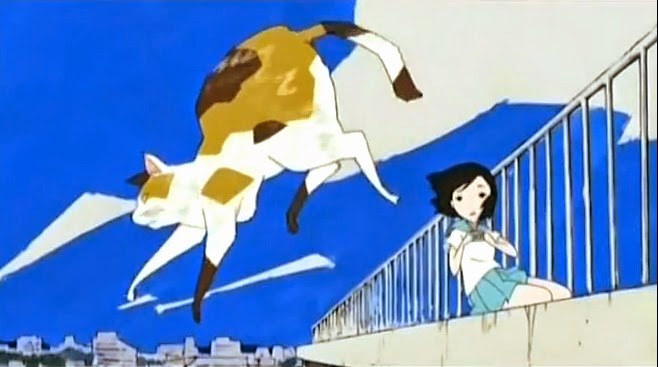
Windy Tales, while
still maintaining a look that can be associated with anime. This look,
with its bright, flat colors with lack of shading and it's simplified
and highly stylized shapes bares a resemblance to images from Japanese
printmaking, such as the woodblock prints of Hokusai. While modern,
western conventions such as linear perspective are used, taken frame by
frame the influence can be seen in some of these less traditional
animated films. An example of this can be seen below in a frame of
Windy Tales when compared to Hokusai's Landscape.
From Windy Tales Ep. 1: Kaze Neko (Wind Cat), 2004, Directed by Junji Nishimura. Animated Film, produced by Production I.G., Tokyo, Japan
Landscape, c. 1835, Katsuhita Hokusai. Woodblock Print, ink on paper.
Musée Guimet, Paris, France
One artist that has gained some popularity outside of Japan for his
similar recognizable art style in animation is Masaaki Yuasa. Yuasa has
directed many animated series, and even got his start on the highly
stylized
Crayon Shin-chan (Clingerman). Although his work
doesn’t stick entirely to one style or another, his vibrant use of
color, wild, flatly-colored simplified characters and backgrounds, and a
variety of techniques that result in melting scenery, exaggerated
motions, and visuals that emphasize emotion over accurate depiction, are
all hallmarks of Masaaki Yuasa’s work. Though he undoubtably gets some
inspiration from Japanese printmaking, his sources are far and wide,
from American to European animation, such as René Laloux's
Fantastic Planet (Clingerman).
From Chibi Maruko-chan: My Favorite Songs, 1992, Key Animation by Masaaki Yuasa. Animated Film, produced by Nippon Animation, Tokyo, Japan.
One of Yuasa’s greatest works is Kaiba, a tale about a mysterious boy
who adventures across planets. It’s somewhat of a reversal of Antoine
de Saint-Exupéry’s
The Little Prince and the classic anime series,
Galaxy Express 999 (GE999).
Instead of traveling farther and farther from home, as in The Little
Prince and GE999, the titular Kaiba wakes up not knowing where or who he
is, and instead is trying to seek out both his identity and his origin.
Along the way, Kaiba meets many strange characters, discovers who he
is, and like in The Little Prince and GE999 learns many lessons along
the way. The abstract representation of the characters pushes both the
messages and emotion. Kaiba deals with loss, betrayal and redemption of
what seem to be the most despicable humans, the importance of every life
form, and topics as far spread as the questioning one’s own sexuality
and even deeper into what makes the self. Kaiba's art style also takes
inspiration from an earlier Japanese source, most resembling the art
from manga and animation produced by Osamu Tezuka, often considered one
of the founders of modern Japanese manga and animation.
From Kaiba Episode 3: Chroniko's Boots, 2008, Directed by Masaaki Yuasa. Animated Film, produced by Madhouse, Tokyo, Japan.
From Kaiba Episode 1: Chroniko's Boots, 2008, Directed by Masaaki Yuasa. Animated Film, produced by Madhouse, Tokyo, Japan.
Tatami Galaxy involves a character, only known as Watashi,
literally “I”, joining his college’s clubs with the goal of finding a
girlfriend. Despite the mundane premise, the story takes an interesting
turn when time turns back and the character repeats a short period of
life in each of the 11 episodes, each time joining a different club.
While it isn’t uncommon for anime or entertainment in general to involve
a faceless, average character so that the audience can relate, Tatami
Galaxy’s main character is more interesting in his lack of identity
because he gains his personality from each of the clubs he attends and
with the help of a devilish character named “Ozu”. Over the course of
the series, the unnamed main character joins a cycling club, joins a
cult, and joins what appears to be a normal reading club, but actually
turns into a scavenger hunt for an 8th year student. All of these clubs
serve to define the identity of this unnamed character. All throughout,
Ozu’s relationship with the main character is both a motivator and an
antagonist, pushing the character forward as well as playing tricks on
the character whenever possible. While Ozu usually gets the character
into trouble, Ozu is just as likely to get him out of trouble. Perhaps
due to its unquestionably Japanese setting, Tatami Galaxy is the work by
Yuasa that most closely resembles Japanese artwork outside of anime and
manga.

From Tatami Galaxy, 2010, Directed by Masaaki Yuasa. Animated Film, produced by Madhouse, Tokyo, Japan.
From Tatami Galaxy, 2010, Directed by Masaaki Yuasa. Animated Film, produced by Madhouse, Tokyo, Japan.
The appropriately named
Kick-Heart was the product of a
successful crowd-funding project fulfilled through the site Kickstarter.
Though only 13 minutes in length and crudely animated, it manages to
still tell an endearing tale with captivating characters. Kick-Heart is a
love story between the down and out wrestler Masked Man M and the
upcoming superstar Lady S. While Masked Man M, the stage name of Romeo
Maki, struggles to keep an orphanage afloat, he wins a match he’s
supposed to throw and finds himself without the funds he needs to repair
and rebuild. While the story is almost cliché in its structure, the
rough animation is a large part of why it’s so interesting and
surprising. It takes the viewer off guard and makes one want to see how
these events play out, even if they know what the end result will be.
Perhaps due to its low budget,
Kick-Heart takes on a rough and
messy look, but instead of looking cheap, it becomes more personal,
resembling Yuasa's own storyboard drawings.
From Kick-Heart, 2013, Directed by Masaaki Yuasa. Animated Film, produced by Production I.G., Tokyo, Japan.
From Kick-Heart, 2013, Directed by Masaaki Yuasa. Animated Film, produced by Production I.G., Tokyo, Japan.
One of the most interesting themes that runs through Yuasa’s work is that of the loss of identity. In
Kaiba,
the memories of every character are contained within small chips that
are easily and frequently lost or destroyed. The upside is if their
memory is saved, the owner can still live after their body is destroyed.
The chips may also be transferred to different bodies, as happens to
the character Kaiba. He occupies the body of a boy, then a stuffed
animal, and later a girl. The girl's body once belonged to Chroniko, who
Kaiba shares a brief encounter with. While developing a friendship,
Chroniko's existence is cut short when her memory is extracted and
destroyed. Kaiba shares a friendship and romantic relationship with
Popo, a girl who similarly inhabits different bodies. While her main
body is female, she inhabits the body of a male while unknowingly
traveling with Kaiba in the body of Chroniko. To complicate things, both
characters have distorted memories so that they don’t understand their
true relationship.
The lack of identity in the example of
Tatami Galaxy’s
main character is that he never has one. He’s just entering college and
has no goals except to get a girlfriend. The only definition to his
character comes from the clubs he attends and the characters around him.
At one point his sexual drive is represented as an overly rambunctious
cowboy, and it’s clear that the cowboy has more personality than the
main character who’s trying to repress him.
The identity of Romeo Maki is obscured as well throughout
Kick-Heart,
both as Masked Man M and as his unmasked identity. While Romeo Maki, he
has a line drawn through his eyes in every scene, so that the viewer
never sees his entire face. In addition, he’s presented as somewhat of a
nameless loser in the wrestling world. While he has talent, he’s forced
to throw his matches so that he never rises up through the ranks and
becomes famous until the end, where he gains fame because of his
spectacular performance in a losing match. Even then his unmasked visage
is so bruised and swollen that it’s impossible for anyone to know who
he is.
Masaaki Yuasa’s work has become more popular in the west recently,
but some of his older work is more obscure. Kaiba still hasn’t had an
official release in the United States, although it’s not impossible to
find the Australian region 4 dvd if you have a region-free player.
Luckily, Tatami Galaxy is available for free, streaming on Hulu, but
it’s a little more difficult to find Kick-Heart. It was airing on
Cartoon Network periodically, but I can’t find any streaming sources. A
few places are selling the blu-ray disk, but for 13 minutes at $15, I
hesitate to recommend it unless you’re already a fan of Yuasa’s work.
More recently, he directed and storyboarded the episode of the Cartoon
Network series Adventure Time titled “Food Chain” and his most recent
series,
Ping Pong is available for free streaming on Hulu,
under the search name "Ping Pong: The Animation". If you’re into
animation, even if you’re not into typical anime, I recommend taking a
look. His work ventures into PG-13 territory, so watch first if you’re
watching with kids. You can get a small taste of what his animation is
like from the opening of Kick-Heart,
here.
Works Cited
Clingerman, Neil. "Sakuga pt.13 - Masaaki Yuasa's Super-Cray Anime". Online video clip.
YouTube. YouTube, 31 Oct. 2013. Web. 4 July. 2014.
 FinchOwl Pocket SP #1